
Hello!
I am a historian of colonialism, decolonisation, politics and memory politics.
My particular expertise is in photography and visual culture.
My field is Southeast Asia, especially Indonesia, and colonialism and its legacies in the Netherlands.
About Me
I am Professor of Global Political History at the Vrije Universiteit Amsterdam (Free University of Amsterdam).
I was trained in Australia, at the University of Sydney (BA Hons I 2001) and the University of New South Wales (PhD 2007). I worked at Deakin University (2021–23) and Monash University (2010–21) in Melbourne, and at the University of Western Australia (2008-10) in Perth.
I’m currently writing a book on war photography in Indonesia under Dutch rule, from the late nineteenth century to independence (1950). Its title is ‘Seeing Like a Soldier: Photography and Colonial Violence in Dutch Indonesia’ and it is contracted to Cornell University Press.
I also have a new research project going on decolonisation, trauma and memory politics, which focuses on Dutch veterans of the Indonesia’s war of Independence and diaspora groups from the former Netherlands Indies in the Netherlands.
Find my full list of publications, talks and and research on the Menu (top).
Recently …
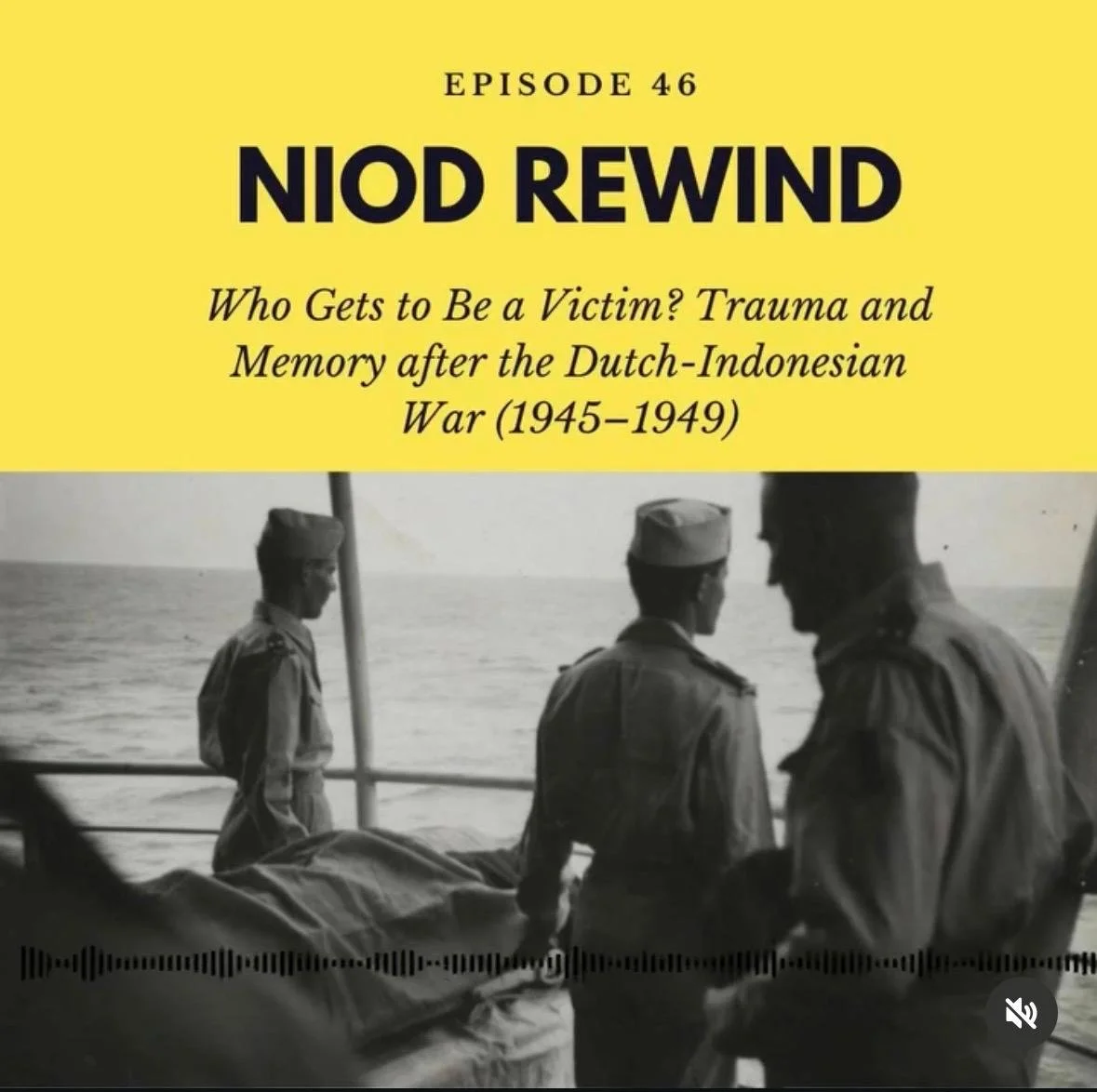
PODCAST: Listen here
I talked with Anne van Mourik from NIOD Amsterdam about how ‘trauma’ has been mobilised in the aftermath of the Indonesia’s War of Independence (1945-9) by members of Indies diaspora and veterans from the Dutch armed forces.
How are these groups implicated in histories of colonial violence? What is ‘perpetrator trauma’? How does trauma show up in everyday life and in political discourse? How is it sometimes used to shape narratives of victimhood that aim to mitigate questions of responsibility?
As the conversation unfolds, we end up circling a familiar knot: why focus on perpetrator trauma at all? Are we in danger of losing sight of historical violence and suffering by shifting attention to memory politics and postwar narratives? Or is this precisely where the political work of history continues to unfold?